
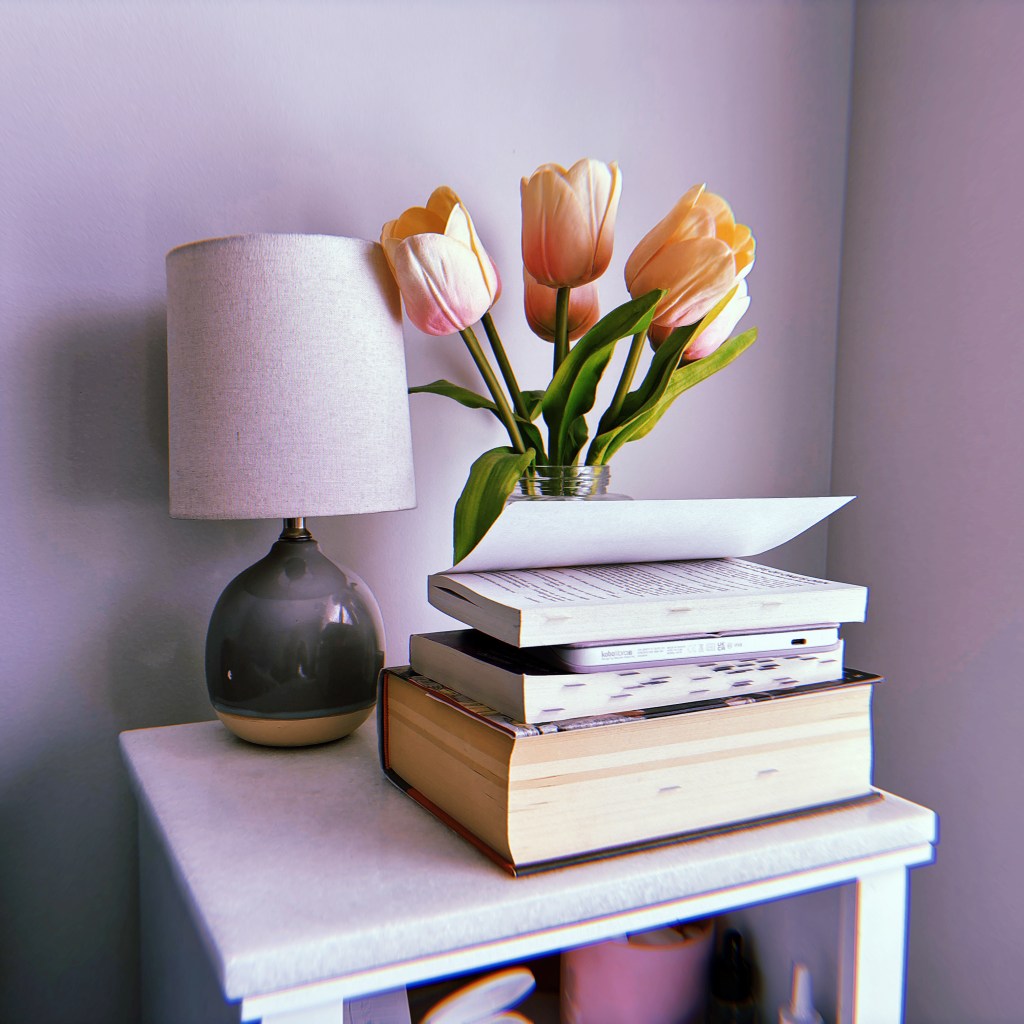
When I’m feeling particularly stressed or anxious, I love reading nonfiction. Sometimes fiction can feel like too much of an emotional investment when I’m already overwhelmed. In those moments, I often turn to nonfiction to help ground myself. Focusing on learning new information in print or by audiobook is a welcome distraction that doesn’t feel soul-crushing like scrolling on my phone does.
If you’re looking for some interesting nonfiction to sink into, here’s some that I’ve read recently.
Strata: Stories from Deep Time by Laura Poppick. Laura Poppick describes stratigraphy– very generally speaking, the study of the order and positions of layered rocks (strata)–as “the humanities of the hard sciences.” As someone who knew next to nothing about geology and stratigraphy before reading this book, I loved that definition. This book is a fascinating exploration of Poppick’s own personal experiences with stratigraphy, the earth over incomprehensible stretches of time, academic perspectives, and what stratigraphy can tell us–and warn us–about our past and future. Her writing itself is also so accessible and engaging. I would love to read more of her writing.

Mattering by Jennifer Breheny Wallace. Rather than focusing on the question, “What is my purpose in life?”, Breheny Wallace invites us to ask ourselves: “Do I feel like I matter?” Through this lens, she emphasizes the importance of feeling like we belong–either in relationships, our community, or even at work. She also discusses how burnout can happen when we feel like we matter too much to others and not enough to ourselves. The idea of “mattering” is is an interesting framework through which to approach life. I’d recommend this to anyone who is feeling stuck or unsure where to turn next.
The Art of Spending Money by Morgan Housel. I loved Housel’s book The Psychology of Money, so I was very excited to pick up this more recent book of his. Here, Housel explores how our spending decisions–and how we feel about our spending decisions– can impact our lives overall. I really appreciated what I took to be the overarching message of the book: spending in and of itself isn’t bad; rather, it’s how you spend money, why you spend money, and what you spend money on in the context of your own life that matters. I think this is a great companion read to The Psychology of Money.
Do you like reading nonfiction? What nonfiction have you read lately? I’d love to know.
Take care xx


 nut free nerd
Leave a reply to Jennifer Cancel reply